
Two questions are shaping many homebuying and selling decisions: Where are mortgage rates headed, and what will happen to home prices?
If you’re thinking about moving before the end of 2026 or sometime in 2027, these forecasts can help you understand the national outlook. They cannot tell you exactly what will happen in your neighborhood, but they can help you plan.
As of November 2026, several major housing and financial organizations expect mortgage rates to remain relatively high through 2027. Home prices are generally expected to continue rising nationally, although the pace may be modest.
Here’s what the latest forecasts suggest and what buyers and sellers should consider before making a move.
In this article:
- What experts forecast for mortgage rates
- What experts forecast for home prices
- What buyers can do now
- What sellers should consider
- Why local housing conditions matter
- How to decide whether to move now or wait
What Do Experts Forecast for Mortgage Rates in 2027?
Many buyers are hoping mortgage rates will fall. However, the latest forecasts suggest that borrowing costs could remain elevated throughout 2027.
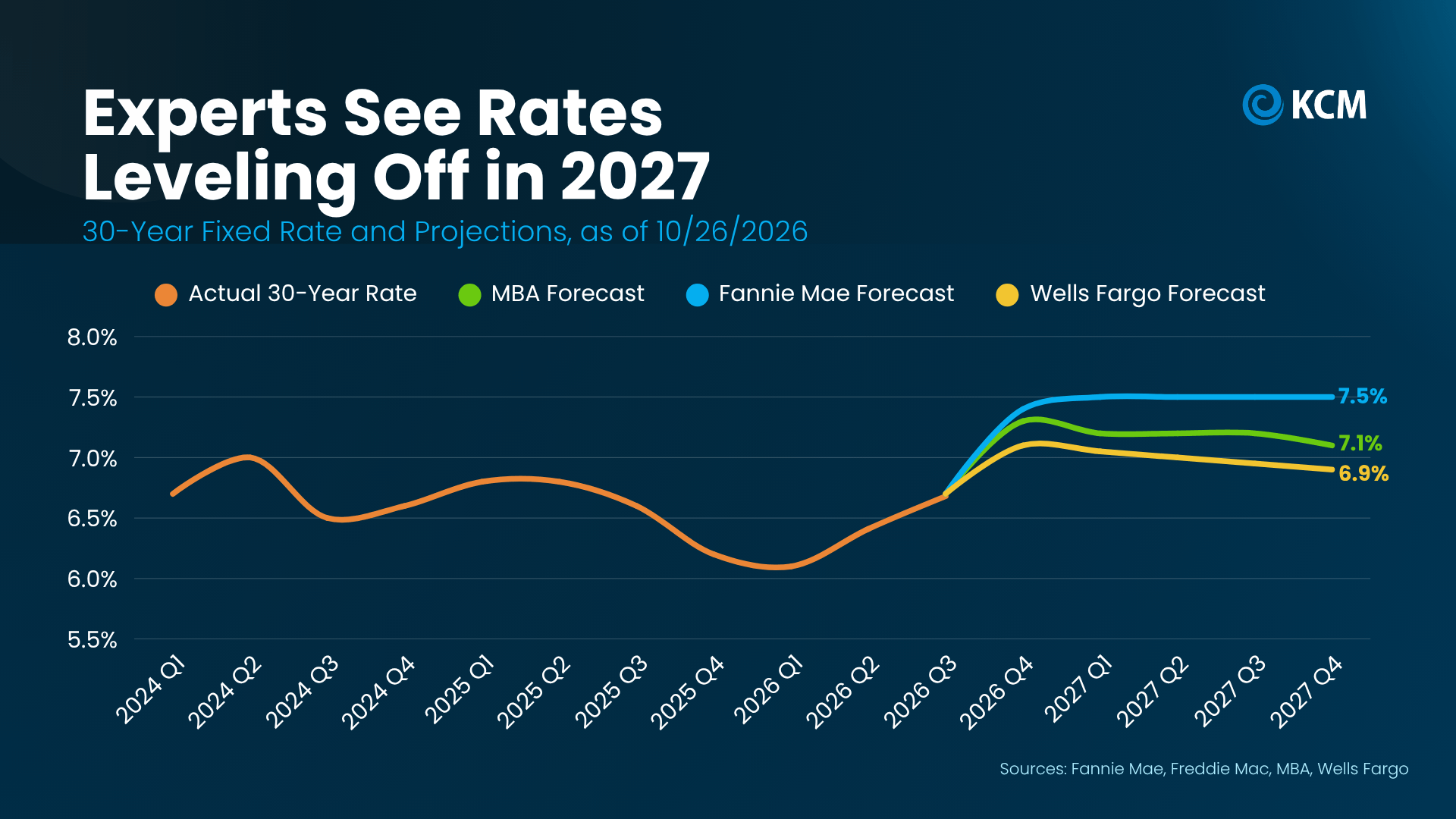
October 2026 projections from Fannie Mae and the Mortgage Bankers Association show a higher-for-longer rate environment.
Fannie Mae expects the average 30-year fixed mortgage rate to reach 7.5% in 2027. The Mortgage Bankers Association expects rates to remain above 7% throughout the year.
These forecasts are not identical, and they may change as economic conditions develop. But both suggest buyers should prepare for mortgage rates that remain around the 7% range rather than count on a major decline.
There is another perspective worth considering. At a live survey during the HousingWire Mortgage Banking Summit on October 1, 2026, 70% of participating mortgage executives expected rates to be around 7.5% or higher six months later.

This was a survey of executives attending that industry event. It should not be treated as a survey of every mortgage lender or a guaranteed prediction of future rates.
What could keep mortgage rates elevated?
Mortgage rates are influenced by several factors, including inflation expectations, Treasury yields, economic conditions, and investor demand for mortgage-backed securities.
The Federal Reserve influences the broader economy and short-term interest rates, but it does not directly set the mortgage rates lenders offer to homebuyers.
That is why mortgage rates can move differently from the Federal Reserve’s policy rate. Even when the Fed changes its rate, mortgage rates may rise, fall, or stay relatively steady.
What can buyers do if rates stay high?
You cannot control the direction of the mortgage market. But you can take steps to understand and improve your financing options.
- Review your credit. Your credit profile can affect the mortgage rates and loan options available to you.
- Compare lenders. Request quotes from multiple lenders and compare rates, fees, and estimated monthly payments.
- Explore different loan programs. Conventional, FHA, VA, and other loan options have different requirements and costs.
- Ask about discount points. Paying points upfront may reduce your interest rate. Compare the upfront cost with the monthly savings and how long you expect to keep the loan.
- Consider seller concessions. Depending on the loan program and negotiations, a seller may contribute toward eligible buyer costs or a rate buydown.
For more guidance, read our article on how to get the best mortgage rate.
What Do Experts Forecast for Home Prices in 2027?
Home prices are another important part of the 2027 outlook. Most forecasts point toward continued national price growth, but experts do not agree on exactly how much prices will rise.
Fannie Mae’s Q3 2026 Home Price Expectations Survey, produced with Pulsenomics, reports that participating experts expect national home prices to increase by an average of 2.2% in 2027.
Other forecasts are more cautious. Goldman Sachs Research projects national home price growth of approximately 0.8% from December 2026 to December 2027.
These projections use different approaches and measurement periods. They should not be combined into one guaranteed price-growth figure.
The important point is that modest national price growth does not mean every home will gain value at the same rate.
Some markets may see stronger appreciation. Others may experience flat prices or declines. Property condition, location, buyer demand, available inventory, and local economic conditions all influence individual markets.
What slower price growth could mean for buyers
Slower appreciation may give some buyers more time to compare homes and evaluate their options. It does not automatically mean homes will become cheaper.
Buyers should focus on the complete cost of ownership, including the mortgage payment, property taxes, homeowners insurance, maintenance, and any applicable association fees.
What slower price growth could mean for sellers
Sellers should avoid assuming that national appreciation forecasts will determine their home’s value.
A realistic asking price should reflect recent comparable sales, competing listings, property condition, and current buyer demand in the immediate area.
Preparation and pricing matter even when the broader market is stable.
What Should Homebuyers Do Before 2027?
If you’re considering buying a home, you do not have to predict the exact direction of mortgage rates to prepare.
Start by understanding what you can comfortably afford today.
- Review your credit and monthly debts.
- Speak with a lender about mortgage pre-approval.
- Compare loan options and estimated monthly payments.
- Set aside money for closing costs, moving expenses, and unexpected repairs.
- Consider how long you plan to stay in the home.
A home should fit your financial situation and your plans. Buying simply because you expect prices to rise can lead to a decision that does not suit your needs.
If you’re still weighing your options, our guide on whether to wait for lower mortgage rates can help you think through the decision.
What Should Home Sellers Consider in 2027?
For homeowners thinking about selling, the national forecast is only one part of the decision.
Your home’s location, condition, competition, and likely buyer pool are more useful when determining a pricing strategy.
Before listing, consider these steps:
- Review comparable sales. Look at recently sold homes with similar features in your area.
- Understand competing inventory. Buyers will compare your home with other available properties.
- Prepare the property. Address visible maintenance concerns and focus on improvements that make sense for your budget.
- Set a realistic asking price. A pricing strategy should reflect current local conditions rather than a national forecast.
- Evaluate buyer concessions. Depending on the offers and financing, eligible concessions may help make a transaction work for both parties.
For additional guidance, explore our resource on pricing your house correctly.
Why Chicago and Chicagoland Buyers and Sellers Need Local Information
National forecasts provide useful context, but they cannot tell you exactly what will happen in Chicago or a particular suburb.
Housing conditions can vary between neighborhoods and communities. A condo in Chicago may face different buyer demand and costs than a single-family home in a nearby suburb.
Property taxes, homeowners insurance, condominium assessments, property condition, and available inventory can all affect affordability and buyer decisions.
That is why local comparable sales and current listing activity matter when evaluating a specific property.
For a more location-focused perspective, visit our Chicago housing market forecast.
Should You Move Now or Wait Until 2027?
There is no single answer that works for every buyer or seller.
Waiting could make sense if you need more time to save, improve your credit, reduce debt, or prepare your current home for sale.
Moving sooner could make sense if your housing needs have changed, your finances are ready, and you find a property that fits your budget.
Rather than trying to predict the perfect month, compare the costs of moving now with the possible costs and benefits of waiting.
For buyers, that means looking at mortgage payments, available homes, and your expected time in the property. For sellers, it means reviewing local demand, competition, pricing, and your next housing plan.
Frequently Asked Questions About the 2027 Housing Market
Will mortgage rates go down in 2027?
Forecasts vary, but several major organizations expect mortgage rates to remain above 7% for much of 2027. These are projections, not guarantees. Economic conditions and financial markets can change the outlook.
Are home prices expected to fall in 2027?
Several national forecasts expect home prices to continue rising modestly in 2027. However, some forecasts are more cautious than others. Individual markets and properties may perform differently.
Should I wait until 2027 to buy a home?
That depends on your finances, housing needs, and the homes available to you. Compare the cost of buying now with the possible benefits of waiting. Do not base the decision on an assumption that rates or prices will move in a specific direction.
Will Chicago home prices follow the national forecast?
Not necessarily. National forecasts do not predict the performance of every city, neighborhood, or suburb. Chicago-area buyers and sellers should review recent local sales, competing listings, and property-specific conditions.
What should sellers do if home prices grow more slowly?
Sellers should focus on accurate pricing, property presentation, and current competition. A realistic strategy based on comparable local sales is more useful than relying on a national appreciation forecast.
Make Your Next Move With a Clear Plan
The 2027 housing outlook suggests that mortgage rates may remain elevated while national home prices continue to grow at a modest pace. But forecasts are not guarantees, and local conditions can tell a different story.
Whether you’re buying, selling, or planning a move in Chicago or the surrounding suburbs, start with your goals and your numbers.
KM Realty Group LLC can help you understand local property options and the real estate decisions involved in your next move. For financing estimates and loan comparisons, speak with a qualified mortgage professional.
The best decision is one that fits your circumstances, not one based only on a national forecast.
Forecast sources: Fannie Mae Economic and Housing Forecast; Mortgage Bankers Association October 2026 forecast; Fannie Mae Home Price Expectations Survey; HousingWire mortgage executive survey; Goldman Sachs Research housing outlook.