
When move-in-ready homes keep landing outside your budget, buying a fixer-upper could be the smartest way to break into homeownership without overextending your monthly payment.
A fixer-upper won’t be the right fit for every buyer. Plenty of families want a property that is ready on closing day. However, homes that need cosmetic or structural updating often sell for significantly less up front—giving first-time buyers and move-up homeowners a way into desirable neighborhoods at a lower entry price.
More buyers are recognizing that advantage right now. As Danielle Hale, Chief Economist at Realtor.com, explains:
“Fixer-uppers give buyers a way to break into the housing market at a time when affordability is still stretched thin. For those with the vision . . . fixer-uppers provide both a starting point in the market and the chance to create a home that’s truly their own.”
Here is why a fixer-upper is worth a closer look—and how the numbers work both nationally and across Chicagoland.
1. The Purchase Price Is Usually 20% to 30% Lower
Because homes needing updates require time and renovation capital, they typically list well below comparable turnkey properties. According to AmeriSave, fixer-uppers commonly sell for 20% to 30% less than updated market-rate homes.
Applying a 25% midpoint discount to national median home prices shows how upfront purchase savings can top $100,000 before renovations begin:
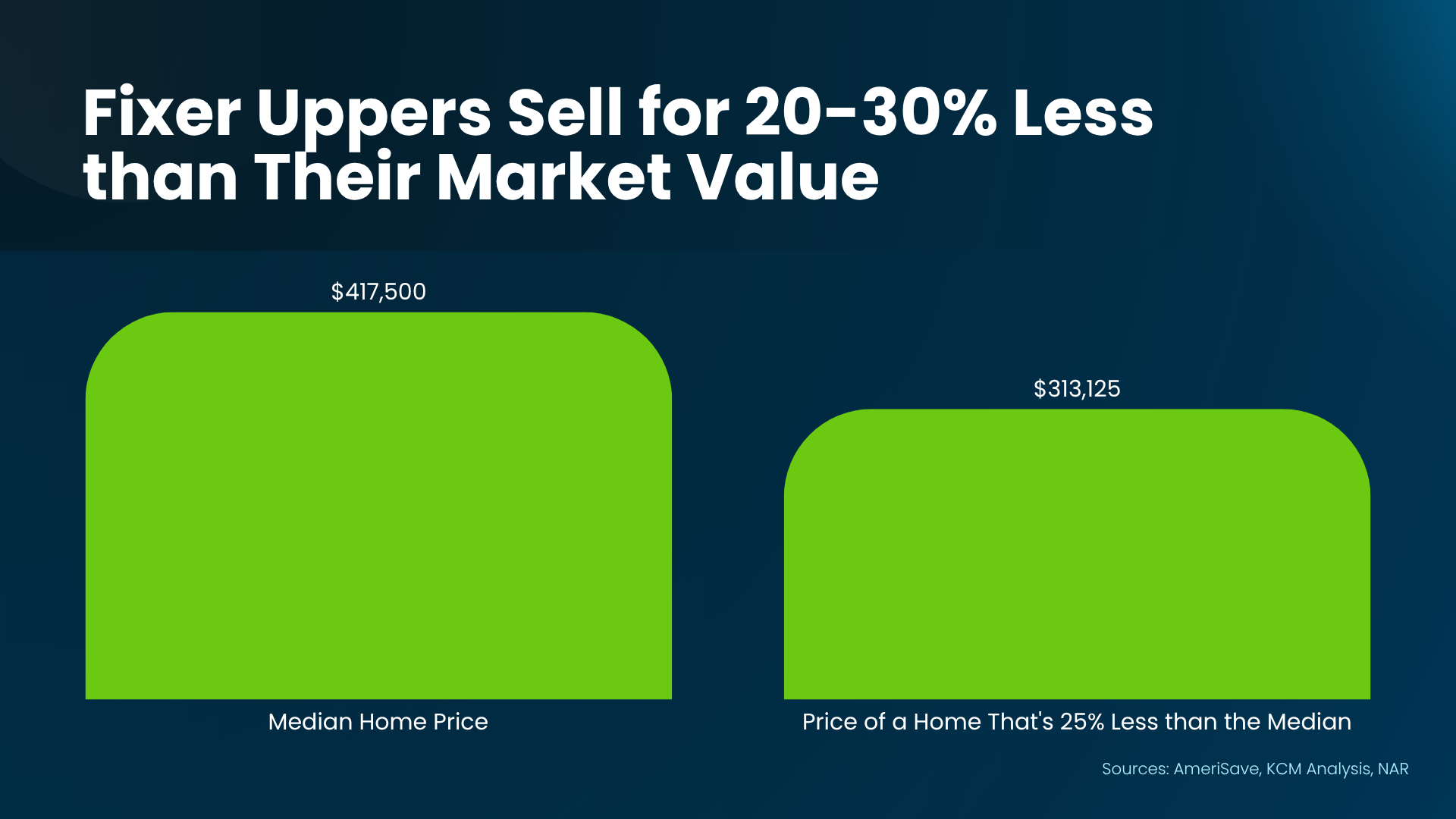
That math is especially relevant in markets where home values are still climbing. According to late-2026 market data from Redfin and the Mainstreet Organization of Realtors, median sale prices sit near $400,000 in the City of Chicago (+5.2% year-over-year) and $420,000 across suburban Chicagoland (+5.0% year-over-year). A 20% to 30% fixer-upper discount on a $400,000 home brings the entry price down to roughly $280,000–$320,000—putting $80,000 to $120,000 in upfront savings back on the table.
Even better, you do not have to finish every cosmetic project on day one; you can phase updates over time as your budget allows. Before submitting an offer, always walk the property with a licensed home inspector and a contractor so your repair budget reflects real labor, material, and permit costs.
2. One Renovation Loan Can Finance Both the Home and Repairs
You do not need tens of thousands of dollars in spare cash to renovate after closing. With a renovation mortgage, you can roll eligible repair and remodeling costs directly into a single monthly mortgage payment based on the property’s projected after-repair value:

| Renovation Loan Program | Best For | Key Benefit |
|---|---|---|
| FHA 203(k) Rehab Loan | First-time buyers with lower down payments (3.5% min.) | Covers minor cosmetic updates (Limited) or major structural work (Standard) |
| Fannie Mae HomeStyle | Conventional buyers & second-home/investment properties | Flexible renovation scope—including luxury upgrades and landscaping |
| Freddie Mac CHOICERenovation | Primary residences, condos, & multi-unit properties | Allows financing up to 75% of the after-completed property value |
| VA Renovation Loan | Eligible veterans and active-duty service members | Combines $0-down VA financing with approved home improvements |
Not every mortgage lender underwrites renovation loans, and each program requires licensed contractor bids before closing. If you are shopping in Chicagoland, browsing Chicago homes under $200K or homes under $300K is a practical starting point to see where renovation financing stretches your budget furthest.
3. Don’t Overlook Local Property Tax Breaks
Many buyers worry that renovating a fixer-upper will immediately trigger a steep property tax jump. Several counties and municipalities offer tax abatements and improvement exemptions to offset that cost:
- Cook County Home Improvement Exemption (Chicagoland): Administered by the Cook County Assessor’s Office, this exemption shields up to $75,000 in added market value resulting from qualifying home improvements from property tax increases for up to four years—and applies automatically once building permits are field-checked.
- Searching Other Counties & Cities: Outside Cook County, visit your official city or county
.govwebsite and search for “[City or County Name] home rehabilitation” or “property tax incentive” to check for local rehab programs.
Frequently Asked Questions About Buying a Fixer-Upper
How much cheaper is a fixer-upper compared to a move-in-ready home?
According to industry estimates from AmeriSave, fixer-uppers typically sell for 20% to 30% less than comparable turnkey homes—often saving buyers $80,000 to $100,000+ up front depending on local median prices and repair scope.
Can I roll renovation costs into my mortgage?
Yes. Programs like the FHA 203(k) loan, Fannie Mae HomeStyle Renovation, Freddie Mac CHOICERenovation, and VA Renovation loans allow eligible buyers to finance both the purchase price and approved repairs in a single mortgage.
Will renovating a fixer-upper raise my property taxes right away?
It depends on local assessment rules. In Cook County, Illinois, owner-occupants who pull proper building permits qualify for the Home Improvement Exemption, which shields up to $75,000 in added improvement value from property tax increases for four years.
Ready to Explore Fixer-Uppers in Your Target Neighborhood?
If turnkey listings keep stretching your budget, a well-located fixer-upper paired with the right renovation loan could be your best path to homeownership. For buyers in Chicago and the surrounding suburbs, Tammy Jackson and the team at KM Realty Group LLC—bringing over 20 years of local brokerage experience—can help you compare after-repair neighborhood comps, evaluate renovation potential, and negotiate the right price.
Browse Chicagoland neighborhoods and suburbs or call KM Realty Group LLC at (312) 283-0794 to start your search.